ATAS Risk Management: Protect Your Accounts from Loss, FOMO and Overtrading
Published September 25, 2026
A built-in risk control system is now available in ATAS. It gives traders practical account-level guardrails designed to limit losses, curb impulsive decisions and bring more discipline to every trading day.
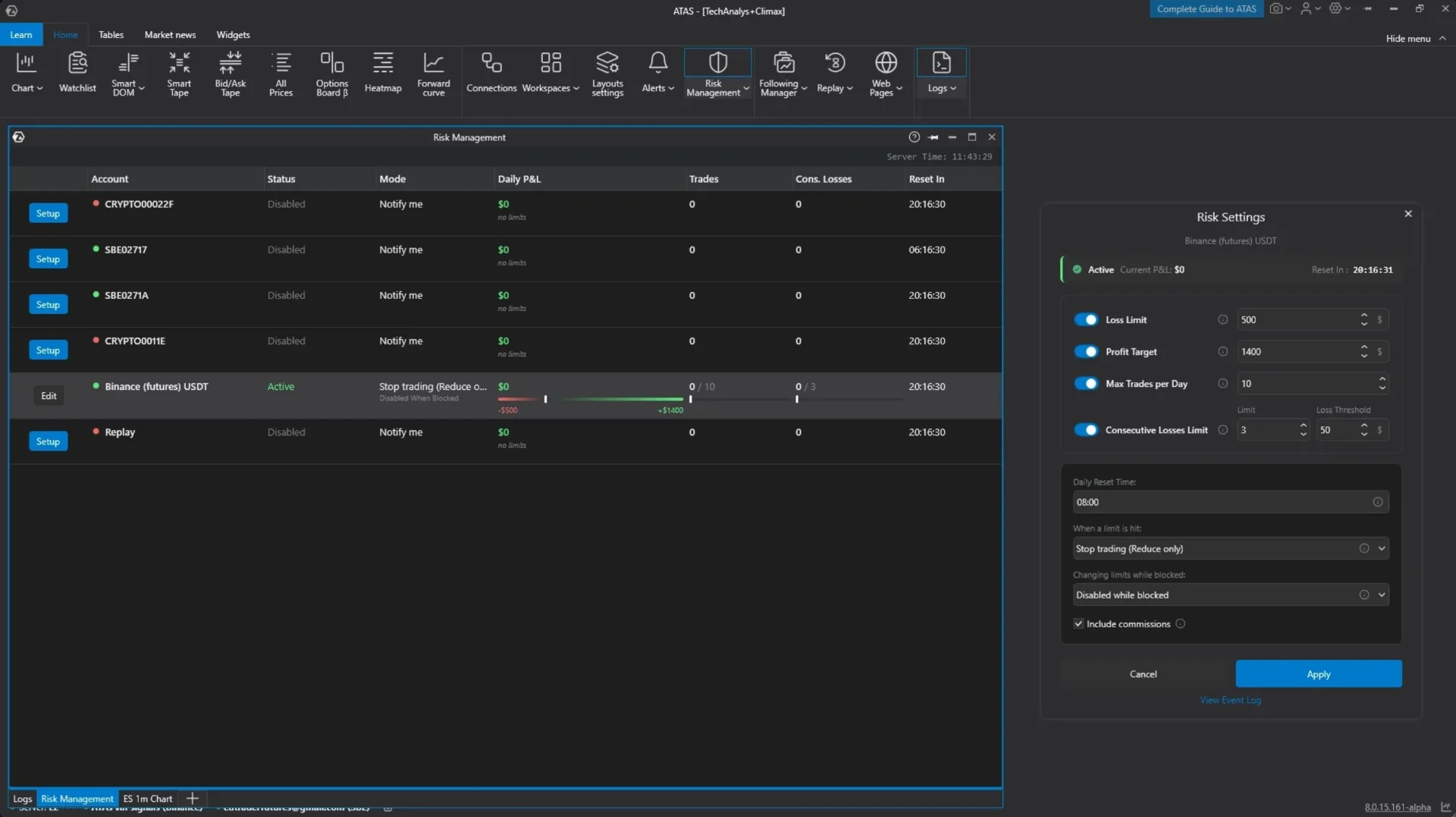
Account-level limits that stay visible
Each account receives its own settings. You can define a daily loss limit, a daily profit target, the maximum number of trades and the maximum number of consecutive losing trades. Current profit and loss, completed trades and consecutive losses update in real time, so the remaining room is always clear.
Daily loss limit
Define how much an individual account may lose during one trading day.
Daily profit target
Set a profit threshold that helps you stop after reaching your planned result.
Trade and loss limits
Cap the number of daily trades and the maximum allowed consecutive losing trades.
Alerts or Reduce Only
Choose a notification or restrict the account to position reductions when a limit is reached.
Protection after a limit is reached
ATAS can simply notify you or switch the account to Reduce Only mode. In that mode, orders may reduce an existing position but cannot increase exposure. An additional setting can block changes to the limits after they trigger, making it harder to disable protection during an emotional moment.
Automatic daily reset
Limit values—including drawdown and profit—are calculated in real time. The established daily limits reset automatically at the beginning of the next trading day, ready for a fresh session without manual intervention.
Why this matters
Risk rules are easiest to break precisely when they matter most. By moving those rules into the platform, ATAS can support traders during loss-chasing, FOMO and overtrading—without relying only on willpower once pressure rises.